
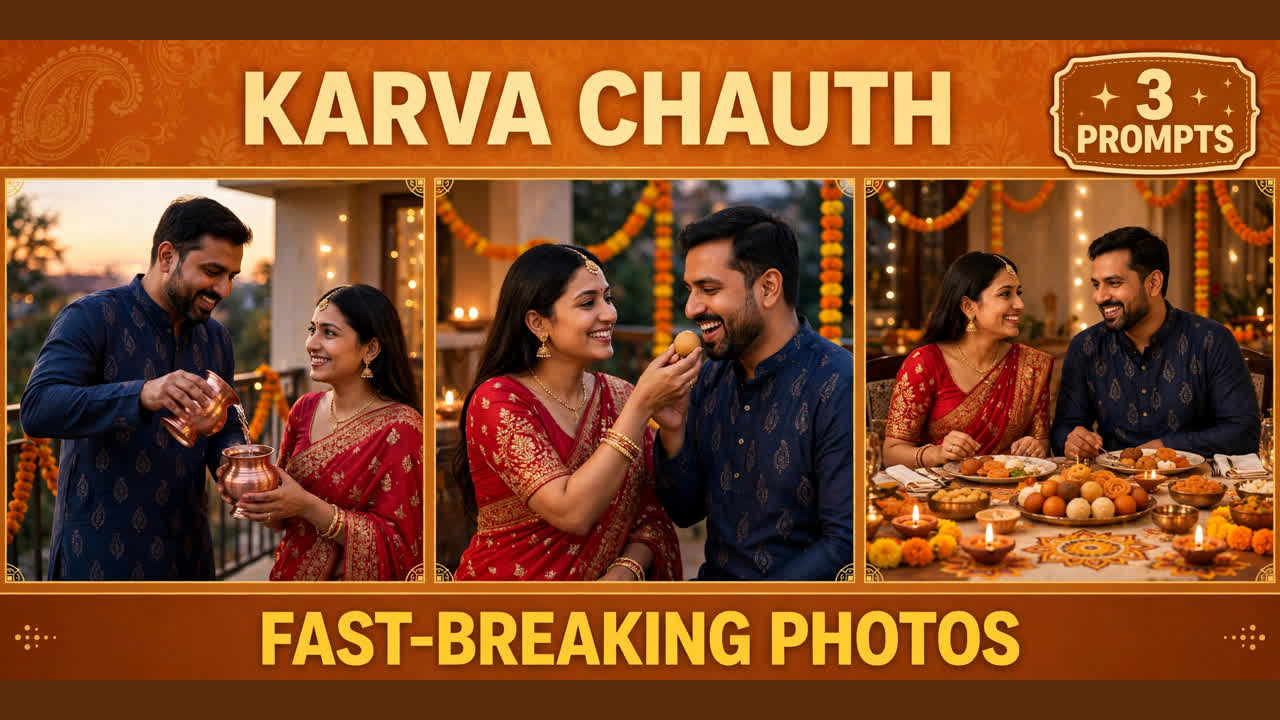
Karva Chauth is a day of quiet devotion. From sunrise to moonrise, married women keep a fast for the long life and well-being of their husbands, and the whole day builds towards a single moment in the evening: the moon appears, the fast is complete, and the family gathers to break it together. It is a tender moment, and it is the moment most families want to keep as a photograph.
That is exactly what this post is about — and it is important to say what it is not. My earlier Karva Chauth portrait post covers only the moon and sieve portraits: looking at the moon through the sieve, gazing at the moon, and the couple portrait under the moon. This post covers only the next moment, after moonrise: the water, the sweet, and the table. If you have already made the moon portrait, these prompts are the natural second half of the story. A karva chauth fast breaking photo is not a replacement for that portrait; it is the warm, everyday scene that follows it.
The timing is why these prompts are appearing now. Karva Chauth falls on Thursday, 29 October 2026, and in the last few days, fast-breaking couple prompts and moon-ritual tutorials have been flooding guides and Instagram tutorials — including a much-shared format of the wife feeding her husband a sweet after the fast, shot like a candid phone photo. The three prompts below follow that same gentle, candid style, written from scratch for this post, so you can make the moment with your own photos.
One honest note before the prompts: the result images in this post are AI-generated approximations of what the prompts produce, not real output from your own reference photos. Your results will look like you and your family, because they start from your photos — these examples start from imagined people, so they show the idea, the framing and the mood, not your faces.
Prompt 1: The First Sip of Water
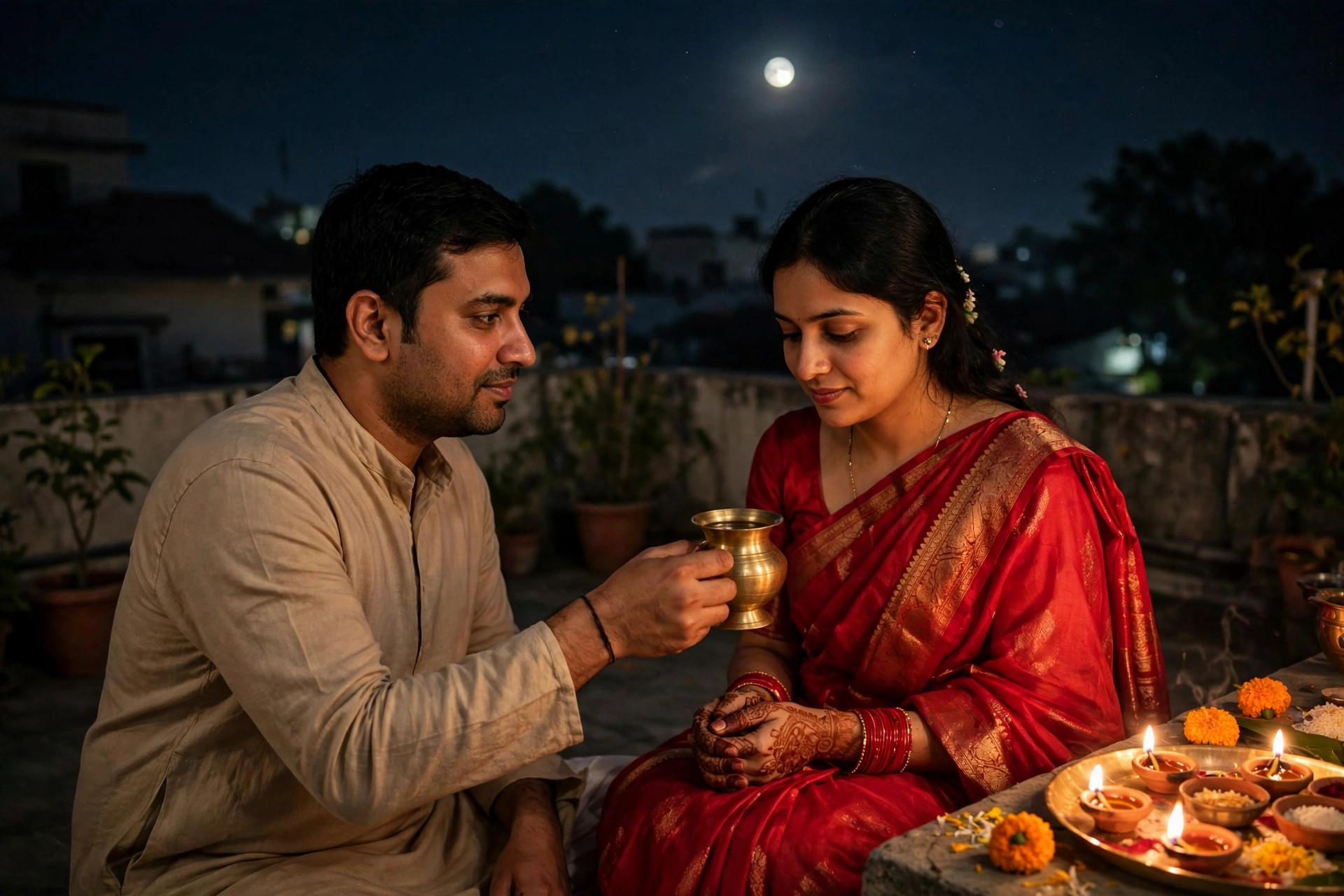
The first prompt is the quietest one, and often the most moving. After a whole day without food or water, the husband offers a small brass lota of water, and the wife takes her first sip under the moon. Diyas glow on the puja thali nearby, her red saree, mehndi and bangles catch the warm light, and nothing else needs to happen. The photograph works because it is still — two people, one small gesture, and a long day coming to a gentle end.
Using AI image generation, transform the uploaded photo of the couple into a warm, respectful Karva Chauth night photograph.
The people: keep both people exactly as in the uploaded photo — same faces, same bodies, same poses. The wife wears a red saree with gold border, mehndi on her hands and red bangles. The husband wears a simple light kurta. Change nothing about their faces or outfits.
The moment: the husband lovingly offers a small brass lota of water towards his wife, and she receives it with both hands, about to take her first sip after the fast. Their expressions are calm, tender and unhurried.
The scene: outdoors at night under a full moon, a lit puja thali with diyas nearby, marigold flowers, warm night light, photorealistic, natural skin texture, candid family-photo feel. No deity images, no text, no logos, no watermarks.
Keep the gesture small. A lota held gently, two hands receiving it, and eyes lowered or meeting softly will always look more real than a dramatic pose. If your first result looks staged, regenerate with the same prompt rather than adding drama — the tenderness is already in the scene.
Prompt 2: The First Sweet Bite
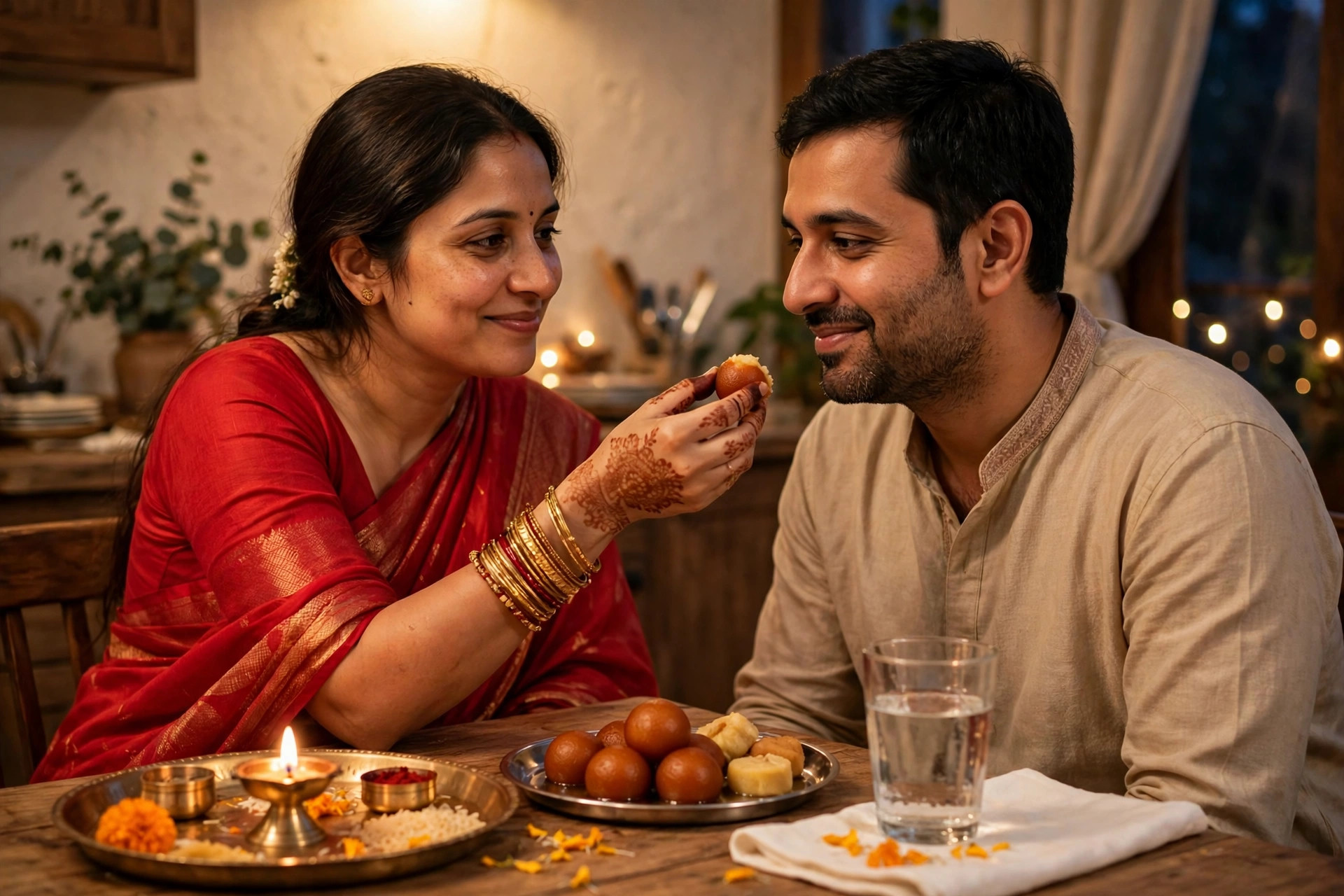
The second prompt is the one most people share. The wife gently feeds her husband the first sweet, and the first bite is shared between them — she offers it, he accepts it, and the day ends with a smile. Shot at the home table, with the puja thali, a plate of sweets and a glass of water still in the frame, it looks like a candid phone photo taken by someone sitting right there. That unpolished, at-home quality is the whole point: this is not a studio shoot, it is a family evening.
Using AI image generation, transform the uploaded photo of the couple into a candid Karva Chauth home photograph.
The people: keep both people exactly as in the uploaded photo — same faces, same bodies, same poses. The wife wears a red saree with mehndi on her hands and gold and red bangles. The husband wears a simple light kurta. Change nothing about their faces or outfits.
The moment: the wife gently feeds her husband a small sweet with her hand, and he accepts it with a soft smile, so the first bite of the evening is shared between them.
The scene: a home dining table in the evening, a lit puja thali, a plate of sweets, a glass of water, warm indoor light, photorealistic, natural skin texture, candid smartphone-photo look, realistic and unpolished, not a studio portrait. No deity images, no text, no logos, no watermarks.
Let the table tell the story. The thali, the sweets and the glass of water in the foreground do more work than any caption could. If a result crops them out, the photo loses its context and starts to look like any dinner photo — so keep the table in the frame and let the sweet be the centre of it.
Prompt 3: The Post-Fast Family Table
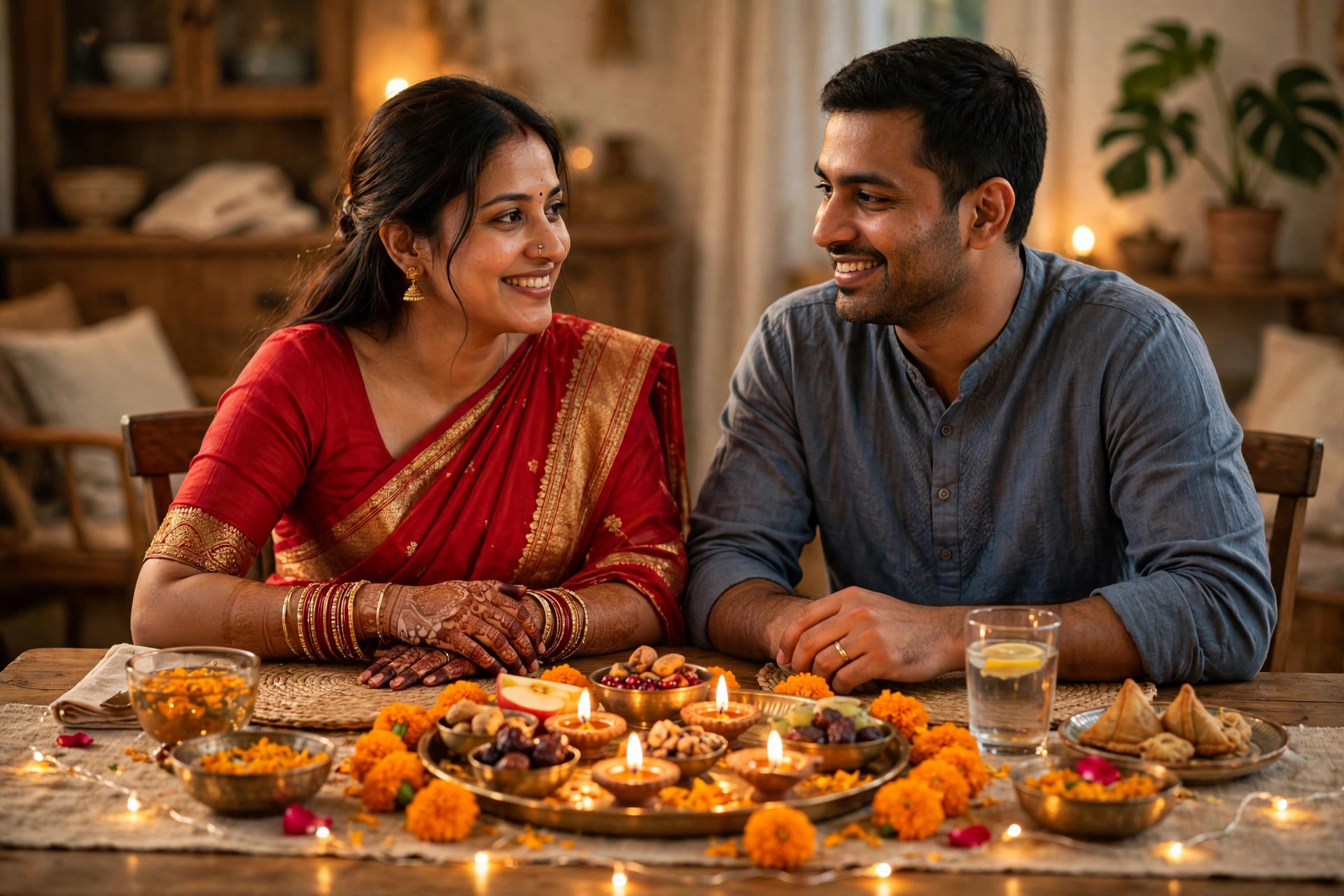
The third prompt widens the frame. The fast is over, the rituals are done, and the couple sits together at a decorated home table — thali, diyas, marigold, warm light, and food shared without hurry. Nobody is posing for a portrait here; they are simply together, relaxed and smiling, the way a family looks after a long and meaningful day. It is the photograph you will come back to in later years, not because it is dramatic, but because it feels true.
Using AI image generation, transform the uploaded photo of the couple into a warm Karva Chauth family photograph at home.
The people: keep both people exactly as in the uploaded photo — same faces, same bodies, seated close together at a table. The wife wears a red saree with mehndi on her hands and red and gold bangles. The husband wears a simple kurta. Change nothing about their faces or outfits.
The moment: the couple sits together after the fast, relaxed and smiling softly at each other, at ease after the day’s rituals.
The scene: a decorated home dining table in the evening, a puja thali with lit diyas, marigold flowers, warm string lights, festive food on the table, warm golden light, photorealistic, natural skin texture, everyday family-photo feel, not a studio portrait. No deity images, no text, no logos, no watermarks.
Do not over-dress the table. A thali, a few diyas and some marigold are enough. A table buried under decorations stops looking like a home and starts looking like a set — and the warmth of this prompt comes from it looking like your home.
How to Make It
1. Start with clear photos of the couple. Front-facing or three-quarter, faces fully visible, good light, no sunglasses. The tool needs to see both faces clearly, because it has to keep both people recognisable.
2. Use only your own photos — or photos you have clear permission to use. These prompts are written for a couple’s own pictures. Never use a stranger’s photo, and never use a celebrity’s photo. Your own photos are also the ones that will mean the most to you afterwards.
3. Open any AI image tool that accepts a reference photo. The prompts below are tool-agnostic — paste them wherever you normally generate images from a photo.
4. Upload your photo first, then paste the prompt. Order matters: the tool reads the uploaded photo as the people, and the prompt as the instruction for what to change. If you paste first and upload second, some tools treat the photo as a style reference instead.
5. If a face drifts, regenerate rather than fixing the result. A fresh generation holds the identity better than an edit on top of a changed face. Keep the identity lines in the prompt untouched — they are doing the most important work in all three prompts.
Tips That Actually Help
Make the moon portrait first, then this one. The two posts are designed to sit side by side: the moon and sieve portrait, then the water, the sweet and the table. Made in that order, they read as one evening, not two separate ideas.
Keep the light warm. Diya light and warm indoor light suit this festival far better than bright white light. If a result looks cold or clinical, the light is usually the reason, not the pose.
Keep the clothes you actually wore. The red saree, the mehndi and the bangles are part of the memory. A prompt that changes the outfit into something fancier may look prettier, but it will feel less like your day.
Post before the festival, or on the night itself. Karva Chauth is on Thursday, 29 October 2026, and these photographs belong to that evening. A fast-breaking photo posted days later still means something to the family, but it will not reach other families who are making theirs that night.
Frequently Asked Questions
Is this the same as the earlier Karva Chauth post?
No. The earlier post covers only the moon and sieve portraits. This post covers only what happens after moonrise: the first sip of water, the first sweet, and the family table. Together they cover the whole evening.
Do I need a couple photo to use these prompts?
Yes, a clear photo of the couple works best, because all three scenes show two people together. A single portrait can still work for the first scene if the tool is asked to keep one person in frame, but the shared moments — the sweet and the table — need both people in the photo.
Why does a face look different in my result?
That is the most common issue with couple prompts, because the tool has to hold two faces steady at once. Start with a sharper, better-lit photo, keep the identity lines in the prompt, and generate a few versions — then keep the one where both faces look most like the original photo.
Can I use these prompts for someone else’s photo?
Only with their clear permission. These are personal, devotional family moments, and a photograph of a couple’s fast is not a stock image. Your own photos, or photos given to you for exactly this purpose, are the right starting point.
Is it respectful to make these images with AI?
Yes, when the image stays faithful to the ritual: no deity images, no jokes at the fast’s expense, no party framing, and no changes to what the fast means. These prompts were written to keep the tone reverent and the scene at home, with the couple, the thali and the diyas — nothing more.
Final Words
The fast ends quietly — a sip of water, a sweet shared, a table full of warmth — and that quiet ending deserves a photograph just as much as the moonlit portrait does. Make your karva chauth fast breaking photo before Thursday, 29 October, while families are making theirs, and keep it as part of the evening, not just as a post.
If you enjoy festive couple formats, my Karva Chauth portrait post covers the moon and sieve moments, and my Diwali couple post covers the next festival a few days later. New formats land in the trending collection every week. If you want to explore AI image tools further, this Google Flow guide is a good place to start.
About Pinky Chouhan
Hey, my name is Pinky Chouhan, and I live in India. I am passionate about discovering new AI trends, AI video tools, and social media content ideas. I also have experience in video and photo editing using tools like CapCut, Adobe, InShot, and VN. Over time, I have worked on many editing projects and enjoy experimenting with new creative techniques and AI-powered tools. I regularly share the latest AI trends, video prompts, and creative ideas on The Prompt Master. My goal is to provide simple and practical prompts that anyone can use to create engaging AI videos. Most of the prompts published on this website are designed to be easy to use. You can simply copy a prompt, paste it into Google Flow or a compatible AI video tool, and start creating your video. I will continue sharing new AI trends, useful prompts, editing tips, and creative ideas to help creators make better content and stay updated with the fast-changing world of AI.