First, the animals had their poetry nights. Now the fruit basket has taken over the TV serial.
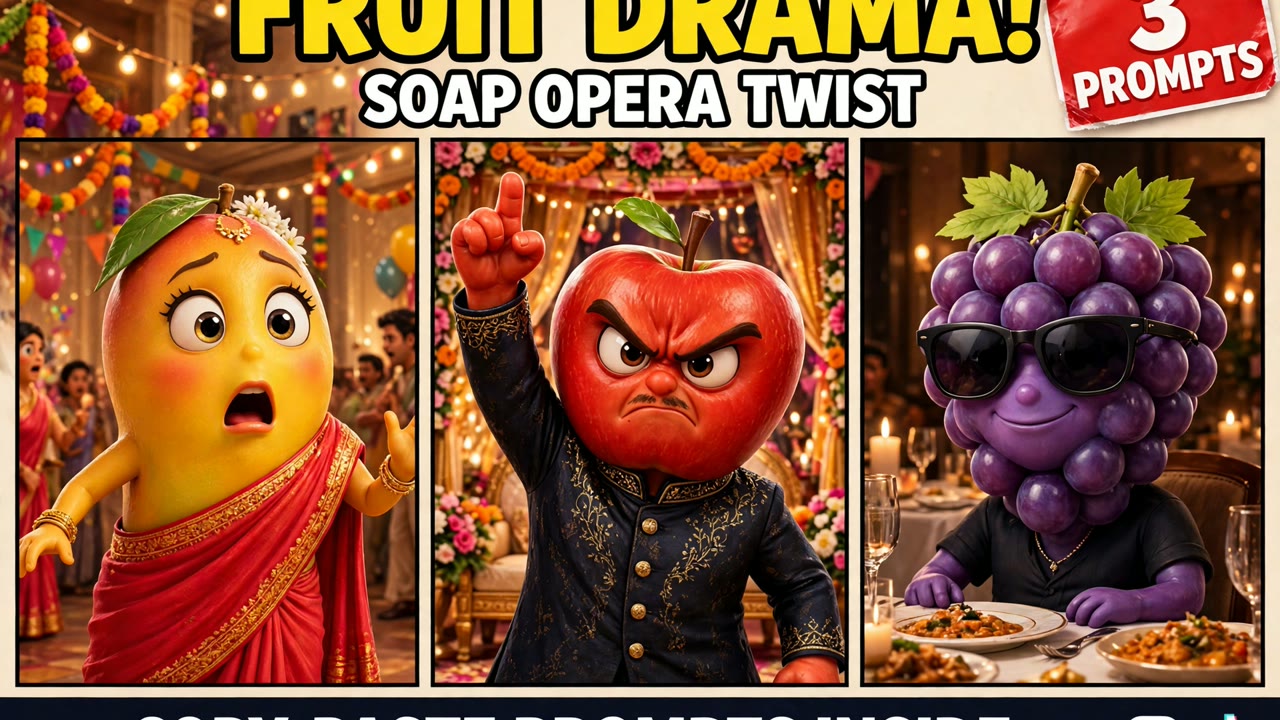
Scroll through any short-video feed this month and you will find them sooner or later: a mango in a saree, gasping at a betrayal. A banana hero with a secret he cannot hide any more. An apple in a dark sherwani, standing up at a wedding at exactly the wrong moment. These little clips copy everything Indian television melodrama is famous for — the shocked close-ups, the three fast zooms, the dramatic pause before a one-line dialogue, and an ending that cuts away right before the answer. The only difference is that the entire star cast comes from a fruit basket.
A quick, honest distinction before we start, because this site already has a cousin of this format. My Mushaira post was about animal characters sitting together and reciting poetry — a calm, literary evening where the joke was the shayari itself. This one is different in every way that matters. There is no poetry here and no stage. Ai fruit drama is pure television melodrama: proper storylines, villains, wedding twists and characters who return from the dead of the fruit bowl. If Mushaira was a poetry reading, this is prime-time TV.
What Is This Format?
The recipe is simple. Take the most dramatic scene a family serial can offer — a betrayal revealed at a party, an objection at a wedding, a long-lost character walking back in — and cast it entirely with fruits. The mango is usually the heroine, dressed up and emotional. The banana makes a wonderful hero with something to hide. Apples, with their shine and smugness, were born to play villains. Grapes travel in bunches, which makes them perfect for a full dramatic family.
What makes these clips so watchable is that the creators take the drama completely seriously. The fruits wear tiny outfits. The lighting is moody. The camera zooms in three times on the same shocked face, exactly like a real serial. And the dialogue is delivered in proper filmy Hindi, the way a TV bahu or a returning villain would deliver it. The comedy comes from the gap between the grand emotions and the fact that the hero is, at the end of the day, a banana.
Most of these videos are made with ordinary AI video tools — one prompt, one short clip, one twist. That is exactly why the format has spread: anyone can shoot an “episode” in minutes, and the story can continue for as many episodes as the creator wants.
How to Make Your Own
Pick any AI video tool. Google Flow, Kling, Runway, Pika — the prompts below are written to work in all of them. There is no special app for this format.
Copy one prompt below and paste it as it is. Each prompt already describes the characters, the outfits, the setting, the camera zooms and the Hindi dialogue line. Do not shorten it — the details are what stop the tool from making a plain, cute fruit video instead of a drama.
Generate two or three versions. The first attempt often gets the expressions right but the timing wrong. The zoom and the pause before the final line are the soul of this format, so keep the version where the cliffhanger lands hardest.
Post it as an episode. These clips work best as a series. End every video on a question, and your viewers will come back asking what happened to the mango.
Prompt 1: The Betrayal Reveal
The classic opener. A party, a happy heroine, and one small object that changes everything — in this case, a ring box the banana hero was hiding behind his back. Watch how much of the drama is carried by zooms and expressions alone.
Create a vertical 9:16 video in cute 3D animation style, staged like an Indian TV soap opera scene.
Setting: a fruit-market party at night, decorated with marigold garlands and warm fairy lights, other fruit guests chatting softly in the background.
Characters: a glamorous mango heroine with big expressive eyes, wearing a tiny red saree and gold jewellery; a banana hero in a cream sherwani who looks nervous.
Scene: the mango is laughing with her friends when she notices the banana hiding a small ring box behind his back. The camera zooms in fast on her shocked face, then on his guilty face — three quick dramatic zooms, like a TV serial. The music mood turns tense. She steps forward, eyes filled with tears, and says dramatically in Hindi: “Tumne mujhse itna bada sach kyun chhupaya?”
End the video frozen on her teary close-up, unanswered — full cliffhanger. No text on screen.
Notice what the prompt does not do: it never explains the secret. The whole engine of a serial is the unanswered question, and your comments section will happily argue about what was in that ring box until you post the next part.
Prompt 2: The Wedding Twist
Every long-running serial needs a wedding that almost happens. Here the orange bride and the watermelon groom are one garland away from being married when the apple decides to speak. The dropped garland is the shot everyone remembers.
Create a vertical 9:16 video in cute 3D animation style, staged like a grand Indian TV soap opera wedding scene.
Setting: a decorated wedding stage with flower garlands, golden drapes and rows of fruit guests in festive outfits.
Characters: an orange bride in a tiny red bridal outfit with a veil; a watermelon groom in a cream sherwani and turban; a villainous apple in a dark sherwani with a smug expression, standing among the guests.
Scene: the bride and groom raise their flower garlands to exchange them. Just before the garlands land, the apple steps forward, raises one hand and declares loudly in Hindi: “Rukiye! Yeh shaadi nahi ho sakti!” Every fruit guest gasps. The bride’s garland slips from her hands and falls in slow motion. Quick dramatic zooms across the shocked faces — the bride, the groom, the guests.
End frozen on the apple’s smug smile, before anyone can ask why. No text on screen.
The apple works so well here because the prompt gives it a costume and an attitude, not just a line. Whenever you write a villain into one of these scenes, dress the part first and the dialogue second — the look is what the audience remembers.
Prompt 3: The Revenge Return
The most loved trick in all of serial writing: the character everyone thought was gone forever walks back in, dressed better than before. This time it is the grape — smaller than everyone at the table, and somehow the most powerful presence in the room.
Create a vertical 9:16 video in cute 3D animation style, staged like an Indian TV soap opera family dinner scene.
Setting: an elegant dining room in a rich family home, a long table set with tiny plates and glasses, warm dramatic lighting.
Characters: a fruit family seated at the table — a banana father, an apple mother and an orange daughter, eating and talking; and a grape character everyone believed was gone for good, now returning in style, wearing tiny sunglasses and a small scarf.
Scene: the family is mid-dinner when the doorway darkens. The grape enters slowly, one step at a time, while the camera pushes in. Every fruit at the table freezes mid-bite and stares in disbelief. The grape removes the sunglasses, looks around the table, and says one cold line in Hindi: “Maine kaha tha na… main wapas aaunga.”
End on the family’s stunned faces, frozen, before anyone speaks. No text on screen.
What sells this one is the freeze. Everybody stops mid-bite, nobody talks, and the smallest character in the room owns the whole scene. If your generated version feels rushed, ask the tool for a slower entry — returns like this are all about making the family wait.
3 Mistakes That Ruin the Drama
Making it cute instead of dramatic. A smiling fruit in a nice setting is just a fruit video. The format lives on shocked expressions, fast zooms, tense pauses and close-ups. If your prompt does not ask for the serial-style camera work, the tool will give you a children’s cartoon instead.
Casting the whole fruit basket at once. Ten characters in five seconds means nobody gets a close-up and the twist gets lost. Keep two or three main fruits per scene. A serial introduces its cast slowly; do the same.
Answering your own cliffhanger. The moment the video explains the secret or finishes the wedding, the story is over and so is the series. End on the question every single time. The freeze frame before the answer is not a mistake — it is the format.
A Few Tips That Actually Help
Write the character descriptions once, reuse them forever. “Mango heroine, red saree, gold jewellery” — save the exact words and paste them into every episode’s prompt. That is how your cast stays recognisable from video to video.
One twist per video. A betrayal or an objection or a return. Serials stretch one twist across a whole episode because that is what makes people wait for the next one.
Give the dialogue to the prompt. Most AI video tools will speak or subtitle a line you write into the prompt. Keep it to one short, dramatic Hindi line per scene — long speeches come out garbled, one-liners land clean.
Keep it family-friendly. The charm of this format is that the drama is huge and the cast is fruit. Clean scenes travel further, get shared by everyone, and never run into trouble with platforms or advertisers.
Number your episodes. “Part 1”, “Part 2” in your caption costs nothing and quietly turns a one-off clip into a story people follow.
Frequently Asked Questions
What exactly is ai fruit drama?
It is a short-video format where anthropomorphic fruit characters — a mango heroine, a banana hero, an apple villain — act out Indian TV serial melodrama: betrayals, wedding twists and dramatic returns, complete with zooms, close-ups and Hindi one-liners. The prompts in this post give you three complete scenes to copy.
Which AI tool should I use?
Any modern AI video tool works — Google Flow, Kling, Runway, Pika and similar tools all accept prompts like these. The prompts are tool-agnostic. Start on a free plan, make one episode, and only consider a paid plan if you get serious about a series.
Do I need to know Hindi to make these?
No. Each prompt above already contains the Hindi dialogue line, written out for you — just copy the whole prompt. And if you prefer, the same scenes work with an English one-liner instead; the drama is in the staging, not the language.
How long should each video be?
Short. Five to fifteen seconds is the sweet spot — long enough for one setup, one twist and one frozen cliffhanger. If your tool makes longer clips, trim to the moment the final line lands.
Can I continue the story with the same characters?
Yes, and you should. Keep your character descriptions identical in every prompt — same fruit, same outfit, same jewellery — and the tools will keep the cast looking consistent enough for viewers to follow the story across episodes.
Is this format okay for kids to watch?
The scenes in this post are deliberately clean — dramatic, but with no violence and nothing adult. If you keep your own episodes the same way, the format is perfectly family-friendly, which is a big part of why it gets shared so widely.
Why does my video look cute instead of dramatic?
Almost always because the prompt was missing the serial ingredients: the fast zooms, the tense pause, the frozen ending. Copy the camera directions in the prompts above word for word and the tone changes immediately.
Final Words
The formula could not be simpler: one fruit basket, one family, one secret too many. Pick a prompt above, generate your first episode, and end it on a question your viewers cannot leave unanswered.
If you enjoyed this cast of tiny performers, you might also like the animal poets of my Mushaira post — and the trending collection gets a new format every week. If you want to explore AI video tools further, this Google Flow guide is a good place to start.
About Pinky Chouhan
Hey, my name is Pinky Chouhan, and I live in India. I am passionate about discovering new AI trends, AI video tools, and social media content ideas. I also have experience in video and photo editing using tools like CapCut, Adobe, InShot, and VN. Over time, I have worked on many editing projects and enjoy experimenting with new creative techniques and AI-powered tools. I regularly share the latest AI trends, video prompts, and creative ideas on The Prompt Master. My goal is to provide simple and practical prompts that anyone can use to create engaging AI videos. Most of the prompts published on this website are designed to be easy to use. You can simply copy a prompt, paste it into Google Flow or a compatible AI video tool, and start creating your video. I will continue sharing new AI trends, useful prompts, editing tips, and creative ideas to help creators make better content and stay updated with the fast-changing world of AI.