
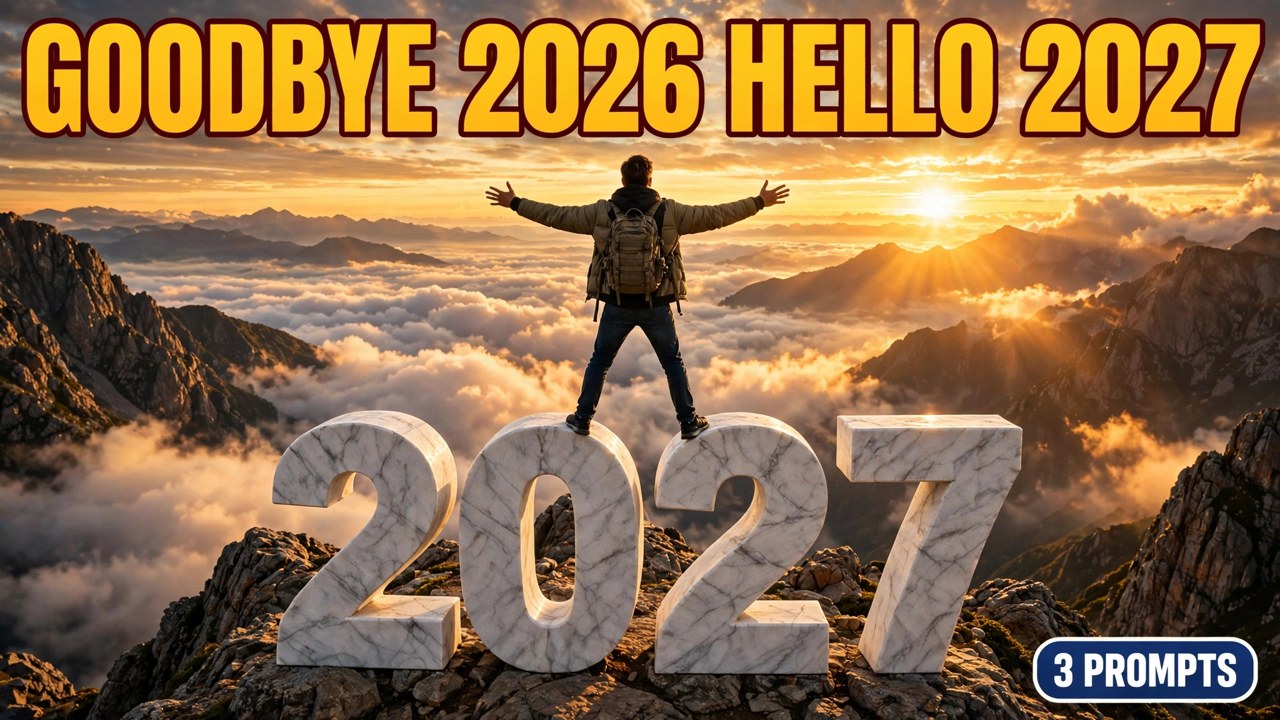
There is a particular feeling in the last days of December. The year behind you feels finished, the year ahead feels wide open, and for a moment you want to stand somewhere high and look at both at once. That is the feeling behind the newest year-change videos: a person climbs giant white marble letters spelling 2027, stands on a mountain peak at sunrise or sunset, opens their arms wide, and lets the camera pull back to show the whole view.
It is a simple idea, and that is why it works. There is no story to follow and no dialogue to translate. One photo of you, one mountain, one huge new year — and the video says everything on its own. The climb is the point: you start low, work your way up the letters, and finish standing tall on the year you are walking into.
Below are three original prompts you can copy and paste. Each comes with a demo video first, so you can see what it produces before you use it. All three work with any image-to-video tool and start from a single photo of yourself. The demos are AI-generated approximations, not true output from a real reference photo — your result will follow your own photo, and that is what makes it personal.
One important note: this is a year-change video, not a hug video. The person climbs the 2027 letters alone and stands on the summit. There is no second version of the person, no meeting, and no hug — videos where two versions of the same person embrace are a different format entirely.
What Is This Format?
The format has one clear shape. The video opens on a mountain peak with giant letters spelling the new year. The person climbs from the base — up steps, or up the letters themselves — until they reach the top. Then they stand on the highest letter, arms wide, while the camera pulls back. The world opens up around them: clouds, ridges, light, and the year they have just climbed into.
Why is it catching on now? The timing is part of it. New Year falls on 31 December 2026, which gives this format a long seasonal runway — people start making year-change videos weeks in advance and keep sharing them into January. It also needs no translation, because the whole message is visual: climb, stand, look forward. And it is optimistic without being sentimental. You are not looking back over the old year. You are climbing into the new one, on your feet, arms open.
It is also easy to remake: no costume, location, or second person — just one clear photo and one prompt. The mountain, light, and letters are supplied by the tool. That is why the prompts insist on keeping your face and outfit the same as in your photo: if the person on the letters does not look like you, it stops feeling like your moment.
Prompt 1: The Sunrise Summit Climb
The flagship version, and the one to make first. You climb onto giant white marble 2027 letters as the sun comes up, golden light breaking over the clouds — the version that best captures a fresh start. Watch the demo first, then copy the prompt below it.
Using AI video generation, create a photorealistic cinematic vertical video (9:16) of a sunrise summit climb, based on the uploaded reference photo.
The scene: a mountain peak at sunrise, with giant white marble letters spelling 2027 on the rocky summit. Golden light breaks over clouds below. The person from the reference photo wears everyday clothes — the same outfit as in the reference photo. Keep their face, hairstyle, and outfit exactly as in the reference photo.
The action: the person climbs steadily up steps onto the giant 2027 letters, then stands on top of the tallest letter as the sun rises behind them, arms wide, looking out over the clouds. The camera starts close on the climb and slowly pulls back to reveal the whole peak, the letters, and the sunrise.
Style: photorealistic, warm golden sunrise light, smooth cinematic camera work, ultra-detailed. Vertical 9:16. Hopeful, triumphant, and calm. No dialogue, no song required, no text overlays except the 2027 letters themselves as part of the scene, no watermarks, no brand logos, no second version of the person, no hug.
The climb should feel earned, not rushed. If the person teleports to the top, the video loses its meaning. The point is the journey upward — steady steps, a pause, then the wide-armed stand. If your first attempt jumps straight to the summit, regenerate and ask for a slower, visible climb.
Prompt 2: The Sunset Peak Stand and Pull-Back
The cinematic version. The climb is already done, and the video is all about the reveal: you stand arms wide on the 2027 letters at sunset while the camera pulls slowly back to show the entire peak. The final wide shot looks like a film poster.
Using AI video generation, create a photorealistic cinematic vertical video (9:16) of a sunset summit stand, based on the uploaded reference photo.
The scene: a mountain peak at sunset, with giant white marble letters spelling 2027 on the summit. Warm orange and pink light fills the sky, clouds glowing below the peak. The person from the reference photo stands on the letters in everyday clothes — the same outfit as in the reference photo. Keep their face, hairstyle, and outfit exactly as in the reference photo.
The action: the person stands tall on the letters, arms open wide, looking toward the horizon as the sun sets. The camera pulls back slowly and steadily, revealing the peak, the full 2027 letters, and the sunset sky, until the person stands small and triumphant against the whole view.
Style: photorealistic, warm sunset light, smooth cinematic camera work, ultra-detailed. Vertical 9:16. Epic, hopeful, and peaceful. No dialogue, no song required, no text overlays except the 2027 letters themselves as part of the scene, no watermarks, no brand logos, no second version of the person, no hug.
Let the pull-back do the work. A close camera makes this look like an ordinary photo. A slow, steady pull-back turns a standing pose into a moment — the world gets bigger, and so does the feeling. If it moves too fast, the reveal is over before the viewer has felt it.
Prompt 3: The Snowy Peak and City Skyline Variant
The variant for people who want something different from the classic mountain shot. The peak is snowy, the 2027 letters glow softly against the dusk, and a city skyline stretches out far below — for anyone whose year was more city than mountain.
Using AI video generation, create a photorealistic cinematic vertical video (9:16) of a snowy summit stand above a city, based on the uploaded reference photo.
The scene: a snowy mountain peak at dusk, with giant glowing letters spelling 2027 on the summit. Far below, a city skyline glows with warm lights. The person from the reference photo wears warm winter clothes over their everyday outfit, keeping their face and hairstyle exactly as in the reference photo.
The action: the person climbs the last few steps onto the 2027 letters, then stands proudly on top of them, arms open wide, looking over the snowy peak and city lights below. Snow drifts gently. The camera moves slowly around the person, then pulls back to show the letters, the summit, and the city in one wide frame.
Style: photorealistic, cool dusk light with warm city lights below, smooth cinematic camera work, ultra-detailed. Vertical 9:16. Proud, hopeful, and calm. No dialogue, no song required, no text overlays except the 2027 letters themselves as part of the scene, no watermarks, no brand logos, no second version of the person, no hug.
Keep the city lights in the background. If the skyline takes over the frame, the letters stop being the star. The city should glow far below while the person and the letters stay clearly in front. If it looks too large, ask for a higher peak and a more distant skyline.
How to Make It
Start with one clear photo of yourself. A full-body or three-quarter photo works best, because the tool needs to see your outfit as well as your face. Good daylight, a simple background, and a relaxed pose will give the most consistent result across all three prompts.
Use your own photo only. The person climbing into the new year should be you. Do not use someone else’s photo or a celebrity’s face. Your own photo is what makes the video meaningful to viewers — they are watching you step into a new year, not admiring a mountain.
Open any image-to-video tool. The prompts work with tools like Google Flow, Runway, Kling, Luma, Pika, or a similar tool. Upload your photo first, then paste the prompt. Without the photo, the tool invents a generic person, and the video loses what makes it yours.
Generate two or three versions and pick the best. Keep the version where the climb is steady, the letters are clean, and the person looks like you. If you are trying the goodbye 2026 ai video format for the first time, start with the sunrise climb — its golden light hides small imperfections.
Tips for a Better Result
Keep the letters clean and readable. The four digits should be unmistakable at a glance on a phone screen. If they come back blurry, bent, or in the wrong order, regenerate before changing anything else — unreadable letters break the entire concept.
Keep the camera slow. Fast movement turns a hopeful summit moment into an action clip. Slow, steady, and wide wins here.
Make all three as a series — sunrise, sunset, snowy skyline, over three days. Viewers come back for the next version, and the window from early December into January is long enough to support it.
Frequently Asked Questions
Do I need a video of myself to start, or is a photo enough? A photo is enough, and a full-body or three-quarter photo works best. Upload one clear photo, paste the prompt, and the tool generates the climb, the letters, and the camera move.
Why do my 2027 letters look wrong in the first attempt? Large text is hard for video tools to render, and letters sometimes come back bent or out of order. Regenerate with the same prompt, or simplify the scene so the tool can focus on the letters. Do not accept a version where the year is unreadable; the year is the whole message.
Can I use someone else’s photo for this? No. Use only your own photo, or one given to you with clear permission. Your face, your climb, your new year.
When is the best time to post this? Any time from early December through the first week of January works. If you are making only one, aim for the days around 31 December 2026. If you are making all three, finish with the sunset version on New Year’s Eve.
Is this the same as the hug trend? No. The hug format shows two versions of the same person meeting and embracing. These prompts do the opposite: one person, alone, climbing giant year letters and standing on a summit — not reunion, but arrival.
Final Words
The formula is simple: one ordinary photo, one mountain, one huge new year. Pick a prompt above, upload your own photo, and make it before the year turns — and for more formats, browse the Trending section. If this is your first goodbye 2026 ai video, start with the sunrise climb and keep the camera slow: sometimes the best way to say goodbye to a year is simply to climb above it.
About Pinky Chouhan
Hey, my name is Pinky Chouhan, and I live in India. I am passionate about discovering new AI trends, AI video tools, and social media content ideas. I also have experience in video and photo editing using tools like CapCut, Adobe, InShot, and VN. Over time, I have worked on many editing projects and enjoy experimenting with new creative techniques and AI-powered tools. I regularly share the latest AI trends, video prompts, and creative ideas on The Prompt Master. My goal is to provide simple and practical prompts that anyone can use to create engaging AI videos. Most of the prompts published on this website are designed to be easy to use. You can simply copy a prompt, paste it into Google Flow or a compatible AI video tool, and start creating your video. I will continue sharing new AI trends, useful prompts, editing tips, and creative ideas to help creators make better content and stay updated with the fast-changing world of AI.