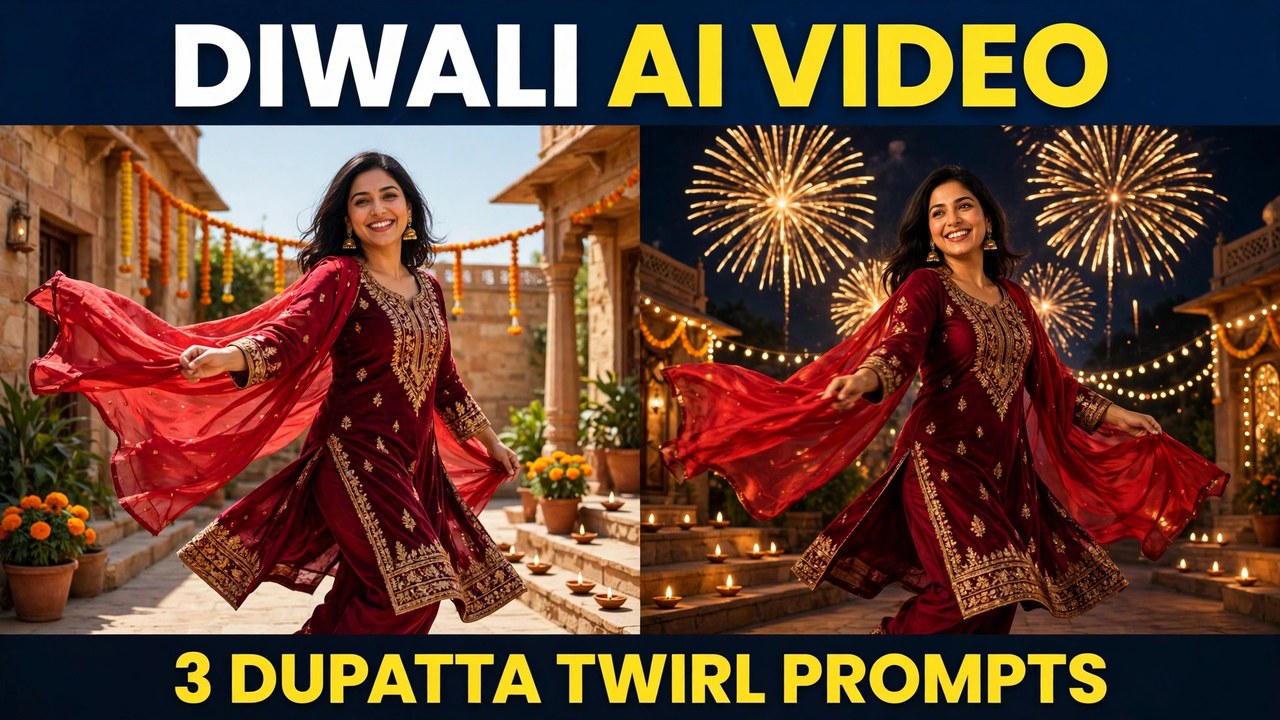
Some Diwali clips do not need a dance, a song, or a crowd. They need one piece of cloth and one change of light. A woman stands in bright daylight, sweeps a red dupatta across the camera, and when the cloth clears, it is night — the same person, the same spot, now standing under bursting golden fireworks. The whole change happens in a few seconds, and it works because the viewer never sees the trick.
That is the moment behind the day-to-night dupatta videos filling Indian feeds in the first days of November 2026, just before Diwali on Sunday, 8 November. At least four big Indian creators posted the same kind of reel on 3 and 4 November: one photo, one red dupatta, one wipe across the lens, fireworks on the other side. If you want to try the diwali ai video format yourself, this post gives you three original prompts that recreate it — a dupatta wipe, a slow orbit with a sparkler, and a spin that ends looking up at the sky. Each one comes with a demo video first.
One honest note before the prompts: the demo videos here are AI-generated approximations, not real output from your own reference photos. They show the idea, the movement, and the mood, not your face — your results will follow your own photo. The demos were also generated at 10 seconds and sped up to fit the 5-second format, with the audio removed, so the movement is a little faster than a real 10-second clip. And the three demos use different illustrative women; your own photo will keep your look consistent.
It is also worth saying what this post is not. It is not a still photograph. My Diwali solo photo post already covers single-person portraits as still images, and my Diwali couple post covers two people together. This post is the video version: motion, a wipe, and a change of light, made for one person alone. It is also not my earlier Navratri fan transition — different festival, different cloth, different reveal.
What Is This Format?
The format has one clear shape. It starts in daylight, with one person facing the camera in festive clothes. The person sweeps a dupatta across the lens in one full sweep that fills the whole frame with red cloth for a beat. While the cloth covers the camera, everything changes: the light falls, the diyas come on, and fireworks fill the sky. When the cloth clears, the same person stands in the same spot at night, looking up at the fireworks.
Why is it spreading right now? It needs no dialogue and no song, so it travels across languages — the wipe and the fireworks say everything on their own. It is easy to remake: one photo, one prompt, one dupatta. And the timing is perfect: make the video by Friday, 6 November, and post it between 6 and 8 November, while the festival is actually in the air.
How to Make One
Start with one clear photo of yourself. A full-body or three-quarter photo works best, taken in daylight, facing the camera, with a plain background. The tool needs to see your face, outfit, and dupatta clearly. A dark or blurry starting photo will give a poor result, however good the prompt is.
Next, open any image-to-video AI tool — the prompts below work with the usual options, including Google Flow, Runway, Kling, Luma, Pika, and similar tools. Upload your own photo before pasting the prompt, or the face and outfit will not stay consistent. Then copy one prompt exactly as written — the lines about keeping your face, outfit, and dupatta, and saying no song, no text, and no other person, stop the tool from changing the format. Generate two or three versions and keep the strongest one. Use your own photo only.
If you are trying this diwali ai video format for the first time, start with Prompt 1. It is the classic version, and it teaches you how the wipe should feel.
Prompt 1: The Dupatta Wipe Day-to-Night Fireworks Reveal
The classic version, and the one to make first. You stand in daylight, sweep a red dupatta across the lens, and when it clears, you are standing under golden fireworks at night. One cloth, one change of light, one reveal.
Using AI video generation, create a photorealistic cinematic vertical video (9:16) of a Diwali day-to-night transition, based on the uploaded reference photo of one person.
The scene: the person stands alone in a decorated courtyard in bright daylight, wearing a festive deep maroon outfit with a red dupatta. Keep their face, hairstyle, and outfit exactly as in the reference photo. Do not add any other person. Do not dress the person as a deity or in a deity costume.
The moment: the person sweeps the red dupatta across the camera lens in one smooth motion, the cloth filling the whole frame for a beat. While the cloth covers the lens, the light changes from day to night. When the dupatta clears, it is night: the same person stands in the same spot under bursting golden fireworks, with diyas and fairy lights glowing around them, and looks up with a soft smile.
Style: photorealistic, smooth steady camera work, ultra-detailed. Vertical 9:16. Silent — no dialogue, music, or song. No text, watermarks, logos, or other people.
Let the cloth fill the frame. A half-hearted sweep that leaves the edges of the daylight scene visible gives the trick away. The dupatta must cover the whole lens for a full beat.
Prompt 2: The Slow 180-Degree Orbit With Sparkler and Fireworks
The cinematic version. The reveal is already done — it is night, the fireworks are up — and the video is all about the camera moving around you. You hold a sparkler at a safe distance and turn slowly as the camera orbits you, and you end facing the camera with a warm smile.
Using AI video generation, create a photorealistic cinematic vertical video (9:16) of a slow Diwali night orbit, based on the uploaded reference photo of one person.
The scene: the person stands alone at night in a decorated courtyard, wearing a festive deep maroon outfit with a red dupatta and holding a lit sparkler at a safe distance from their face. Golden fireworks burst in the dark sky, and diyas and fairy lights glow behind them. Keep their face, hairstyle, and outfit exactly as in the reference photo. Do not add any other person. Do not dress the person as a deity or in a deity costume.
The moment: the person turns slowly as the camera orbits them 180 degrees, revealing the diyas, fairy lights, and fireworks from a new angle. The sparkler’s golden light catches their face. They end the turn facing the camera with a warm smile.
Style: photorealistic, warm golden night light, smooth cinematic camera work, ultra-detailed. Vertical 9:16. Silent — no dialogue, music, or song. No text, watermarks, logos, or other people.
Keep the orbit slow. A fast camera move turns a graceful turn into a dizzy spin. A slow, steady orbit lets the viewer take in the lights one by one.
Prompt 3: The Dupatta Spin and Fireworks Look-Up
The joyful version. No wipe, no orbit — just a spin. You turn once under the fireworks, your red dupatta flowing out around you, then you stop and look up at the sky. It is the simplest of the three, and often the one people watch twice.
Using AI video generation, create a photorealistic cinematic vertical video (9:16) of a Diwali night spin, based on the uploaded reference photo of one person.
The scene: the person stands alone at night in a decorated courtyard, wearing a festive deep maroon outfit with a flowing red dupatta. Golden fireworks burst in the dark sky above, and diyas glow softly on steps and ledges around them. Keep their face, hairstyle, and outfit exactly as in the reference photo. Do not add any other person. Do not dress the person as a deity or in a deity costume.
The moment: the person spins once, the red dupatta flowing out around them, then stops and looks up at the fireworks with a joyful expression. The camera stays steady, framing the full spin and the upward look.
Style: photorealistic, warm golden night light, smooth steady camera work, ultra-detailed. Vertical 9:16. Silent — no dialogue, music, or song. No text, watermarks, logos, or other people.
One spin, not three. A single graceful turn reads as celebration. Two or three spins in a row read as a dance routine.
Tips That Actually Help
Keep the dupatta red. A red dupatta reads instantly on camera, in daylight and at night. A pale or patterned dupatta can wash out against the daylight sky or disappear against the night.
Post the three as a series. Dupatta wipe, slow orbit, spin and look-up — three videos, three days. Make them by Friday, 6 November, and post them across the Diwali weekend, with the fireworks look-up on Diwali night itself.
Do not add a song. Some versions run to a well-known track, but you do not need one, and a copyrighted song can get a post muted or removed.
A Note on Real Fireworks Safety
These prompts make videos, not instructions for handling fireworks. If you celebrate with real fireworks, keep a safe distance and never hold a firework near your face. Sparklers burn far hotter than they look and should be held at arm’s length, away from loose clothing and hair, with children supervised by an adult at all times. Light diyas on a stable surface, away from curtains, and never leave a flame unattended. The safest version of any of these videos is the AI version: the light is in the clip, and no real flame is anywhere near you.
Frequently Asked Questions
Do I need a video of myself to start, or is a photo enough?
A photo is enough. A clear full-body or three-quarter photo of yourself in daylight works best. Upload it, paste the prompt, and the tool generates the rest.
Which tool should I use?
Any image-to-video tool works, including Google Flow, Runway, Kling, Luma, Pika, and similar tools. Start on a free tier and make a test video first.
Why does my result look different from the demo video?
Because your result starts from your photo, while the demo starts from an imagined person. The movement and mood should feel similar, but the face will follow your photo, not the demo.
Is this the same as the Diwali solo photo post?
No. That post is still images: rooftop fireworks, a single diya, and a sparkler glow as photographs. This post is video: a dupatta wipe, a camera orbit, and a spin.
Can I make a couple version from these prompts?
These prompts are for one person only. For a two-person Diwali portrait, use my Diwali couple post instead.
Final Words
Diwali videos do not need a crowd to feel festive. One red dupatta, one change of light, and one look up at the sky can carry the evening. If you try this diwali ai video format, start with the wipe and make it before Friday, 6 November.
And if you want more festival formats, new looks land in the trending collection every week. If you want to read more about AI video tools, this Google Flow guide is useful.
About Pinky Chouhan
Hey, my name is Pinky Chouhan, and I live in India. I am passionate about discovering new AI trends, AI video tools, and social media content ideas. I also have experience in video and photo editing using tools like CapCut, Adobe, InShot, and VN. Over time, I have worked on many editing projects and enjoy experimenting with new creative techniques and AI-powered tools. I regularly share the latest AI trends, video prompts, and creative ideas on The Prompt Master. My goal is to provide simple and practical prompts that anyone can use to create engaging AI videos. Most of the prompts published on this website are designed to be easy to use. You can simply copy a prompt, paste it into Google Flow or a compatible AI video tool, and start creating your video. I will continue sharing new AI trends, useful prompts, editing tips, and creative ideas to help creators make better content and stay updated with the fast-changing world of AI.